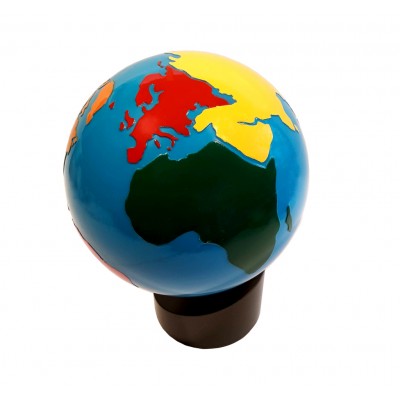
The category includes tactile, visual tools that transform abstract concepts (continents, countries, oceans) into concrete experiences for children, using globes, puzzle maps, diagrams and models to explore the world, develop spatial orientation and cultivate respect for the diversity of the planet.
What they include and how they work:
Montessori Globes: They are often divided into colors that represent land (abrasive areas) and water, providing an immediate visual perception of the distribution of continents.
Puzzle Maps (Continents): Children assemble puzzles with the shape of the continents, learning their names and positions through direct manipulation, often with pieces with handles (buttons) for easy gripping.
Slides and Cards: Sets of cards that present details about countries, flags, animals, cultures, stimulating curiosity and knowledge.
Landform Sets (Earth-Water): Trays with three-dimensional shapes that show how mountains rise from water, another concrete way to understand physical geography.
Benefits of these materials:
Authentic Learning: The child learns through personal experience, not just by memorization.
Skill Development: Improves hand-eye coordination, spatial orientation, vocabulary and attention.
Connecting with the World: Makes the big, abstract world accessible and understandable, cultivating an attitude of explorer and citizen of the world.
Independence: They are self-correcting (if the piece doesn't fit, it's out of place), allowing the child to work independently.
In short, Montessori geography materials transform the study of the world into a tactile and visual adventure, laying the foundation for a deep understanding of our planet.