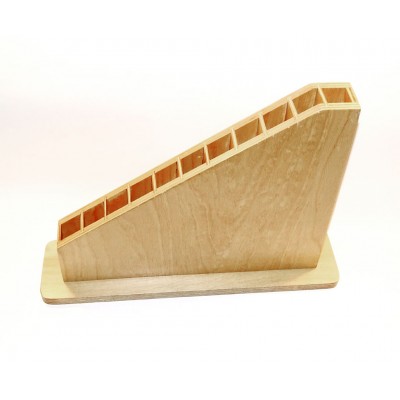
Montessori materials in the "Sensorial" category are specific educational tools, made of natural materials (wood, metal, textiles), designed to refine the child's senses (sight, hearing, touch, smell, taste, proprioception) through the concrete exploration of differences in color, shape, size, weight, texture, sound, helping him understand abstract concepts in a tangible form and develop concentration, coordination and autonomy.
What it means:
Refining the senses: Children compare objects (colored cubes, sound cylinders, tactile boards) to distinguish subtle nuances, becoming more attentive to details.
Concreting the abstract: Symbols such as colors, shapes, sizes are presented in real objects (e.g. color blocks) to make abstract concepts accessible to the child's mind.
Manipulative Learning: Through free play, children explore, sort, classify, and order, building a solid foundation for math, language, and other subjects.
Autonomy and Focus: Materials are self-correcting, allowing the child to discover mistakes on their own, encouraging independence.
Examples:
Pink Tower: Develops visual perception of size.
Brown Ladder: Introduces the concept of thickness.
Sound Cylinders: Trains fine hearing.
Tactile Boards: Explores different textures.
Essentially, Montessori sensory materials transform sensory exploration into a structured learning activity, essential for the child’s cognitive and motor development, according to the principles of Dr. Maria Montessori